Rating: 4.5/5
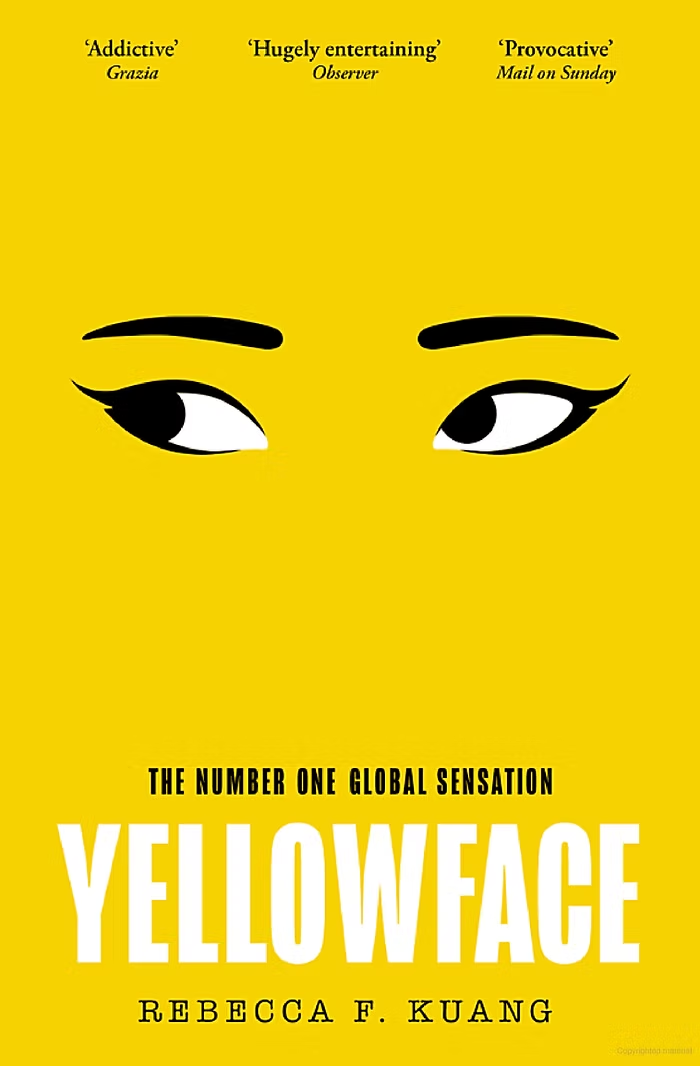
R.F. Kuang’s Yellowface is one of the most provocative and sharp-tongued novels of recent years, plunging headfirst into the murky, competitive, and often performative world of modern publishing. It begins with an outrageous act: June Hayward, a struggling white writer, witnesses the sudden death of her literary peer, the brilliant and beloved Athena Liu. In a moment of panic, or perhaps opportunity, she takes Athena’s unpublished manuscript, rewrites it, and releases it under the racially ambiguous pen name “Juniper Song.” What unfolds is not only a literary thriller but a deep, satirical exploration of authorship, identity, and the social economy of storytelling.
At its core, Yellowface is a study of appropriation, not just of a manuscript, but of voice, of cultural capital, of the right to be seen and heard. Kuang doesn’t hand over neat answers to the question of who is allowed to tell what story. Instead, she forces readers to sit in discomfort as June’s justifications mount: she’s done the research, she has good intentions, and the industry is rigged anyway, so why shouldn’t she succeed? Through this unreliable narrator, Kuang captures the entitlement and self-delusion that often underpins conversations about race and representation in creative spaces.
“In destroying her, we create moral authority for ourselves.”
Yellowface: All About Publishing?
The publishing industry itself becomes a living character, flawed, fickle, and hungry for marketable narratives. Kuang’s critique is laser-focused: on diversity being reduced to marketing metrics, on marginalised writers being pigeonholeed into trauma narratives, and on how even scandals can be spun into bestsellers. The book also turns its gaze on social media, where outrage fuels engagement and authenticity becomes a performance. We’ve all seen Twitter pile-ons and Goodreads takedowns. Here, Kuang dares readers to acknowledge their complicity in this spectacle-driven digital culture.
What makes the reading experience especially compelling is the narrative perspective. June is loathsome, yes, but she’s also worryingly relatable. Her voice is confident, persuasive, and, at times, disturbingly rational. Kuang knows that hate-reading wears thin fast, so she carefully crafts a protagonist whose self-justifications often mirror the very excuses readers might hear—or give—in real life. Athena, despite being dead for most of the novel, looms large, haunting the narrative as a symbol of how identity is celebrated and controlled within publishing. Their relationship, equal parts obsession and rivalry, is both deliciously toxic and thematically rich.
Yellowface is also fiercely metafictional. It knows it’s being read by people who live online, by those who tweet about books, who track author controversies, who review everything. Even reviewers aren’t spared Kuang’s scrutiny, as she slyly critiques the line between ego-driven hot takes and genuine literary criticism. And yet, she does it all without moralising. Instead, she invites readers to interrogate their own biases, discomforts, and assumptions.
“Isn’t that what ghosts do? Howl, moan, make themselves into spectacles?”
My Conclusion About Yellowface?
While the satire is mostly effective, there are moments where the novel leans a little too hard into its commentary. The final act borders on theatrical and the abundance of pop culture references may date the book sooner than expected. Still, it’s a compulsively readable, wildly uncomfortable, and ultimately unforgettable novel. Kuang’s prose is punchy and self-aware, her insights sharp and devastating.
In the acknowledgements, Kuang describes the novel as a horror story about loneliness in a fiercely competitive industry. That description couldn’t be more fitting. Yellowface is a novel about ambition and isolation, about being seen and being consumed. It’s a takedown of the inner workings of publishing and a broader commentary on how art, identity, and scandal are commodified for profit.
This isn’t a story of redemption. It’s a story of unravelling. And it will stay with you long after the final page.